Blog
Personal finance, budgeting tips, and biriqim insights
31 articles


Assign a specific purpose—such as spending, saving, or a goal—to each portion of your income; set up a zero-based budget using flexible categories and regular reviews.
Read more
Correctly categorize fixed, variable, semi-variable, and periodic expenses; establish a simple categorization system that highlights the areas you can control.
Read more
Measure the impact of hypothetical scenarios—such as exchange rates, inflation, and market volatility—on portfolio allocation; interpret the limitations of the results without considering them as investment advice.
Read more
Track your minimum payment, remaining statement balance, and financing costs separately; see how your payment choices affect your available budget for future months.
Read more
Evaluate the budgeting app that best suits your needs based on usage habits, privacy, category flexibility, support for multiple assets, receipt scanning, and reporting criteria.
Read more
View your debt, income, essential expenses, and payment dates all in the same table; test your cash flow with different scenarios before considering a restructuring option.
Read more
Compare month-over-month and year-over-year changes by category; gain a more accurate understanding of spending trends by separating seasonality from the base effect.
Read more
Separate planned and actual amounts; create a realistic monthly plan by combining recurring expenses and weekly checks into a single system.
Read more
Create an updated cash flow forecast by evaluating expected revenue, mandatory expenses, debt maturities, and uncertainties across three distinct time horizons.
Read more
Understand portfolio value, cost, return, allocation, risk, and currency effects in context; recognize why data serves as input for decision-making rather than a recommendation.
Read more
Correctly interpret the investment profit and loss statement using concrete examples, distinguishing between average cost, current value, and realized and unrealized results.
Read more
Define your savings goal in terms of purpose, amount, timeline, and monthly contribution; create a savings plan that fits your actual budget and is both measurable and flexible.
Read more
Learn how to calculate portfolio allocation, identify concentration risk, and understand why true diversification involves more than just the number of assets.
Read more
Track your cash flow by income and expense dates; by identifying payment peaks early on, you can plan your budget more realistically and minimize surprises.
Read more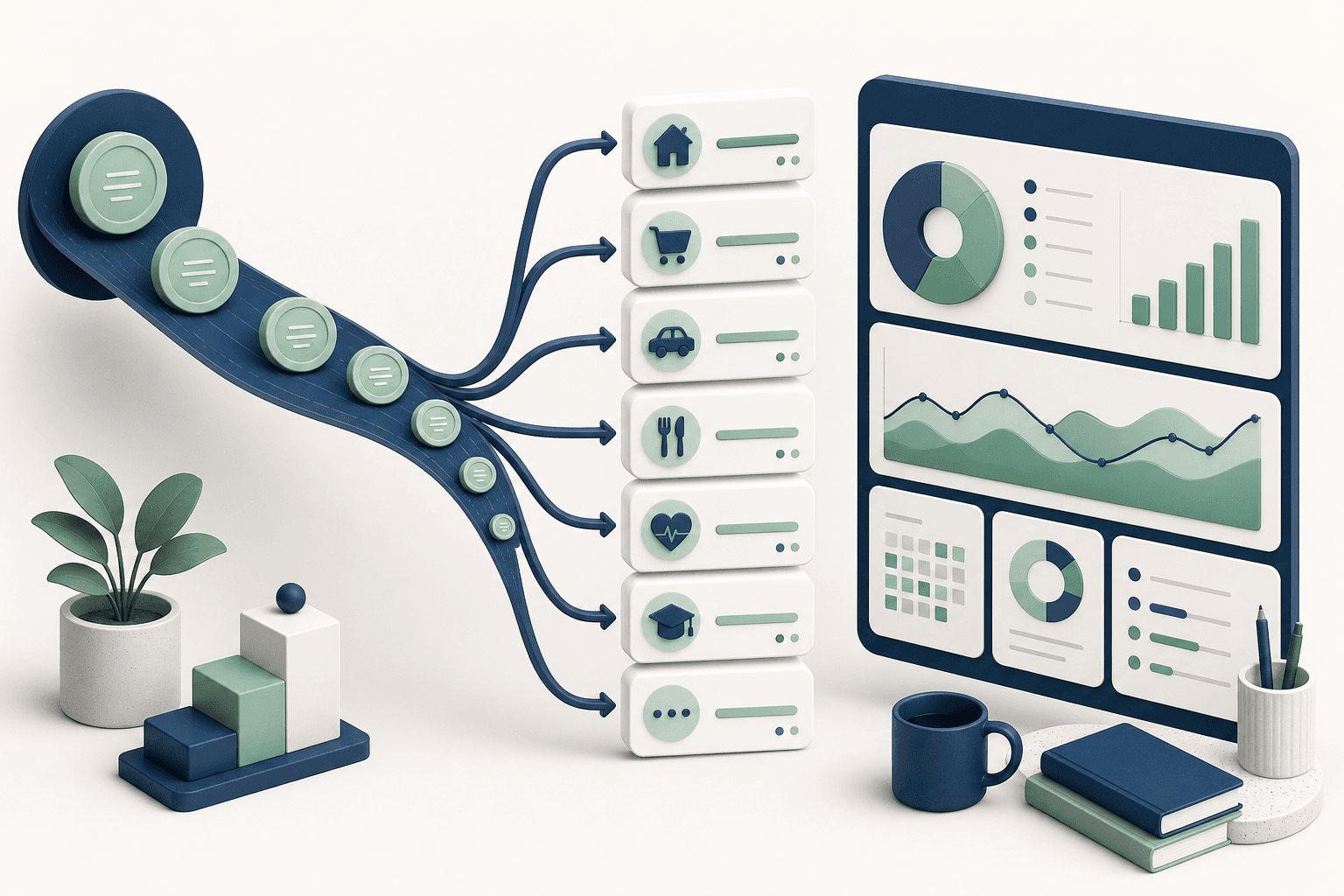
Track your income and expenses using simple categories; make small payments visible and reduce end-of-month surprises with regular weekly checks.
Read more
Verify card transactions, separate subscriptions and financing costs; identify recurring unnecessary expenses using specific filters.
Read more
Learn the basic steps to establishing a sustainable personal finance system by tracking your income, expenses, debt, savings, and assets all in one place.
Read more
Create a realistic, flexible, and long-term sustainable monthly budget by balancing your net income, essential expenses, and savings goals.
Read more
Find out how to organize your records for quantity, cost, exchange rates, and categories so you can track stocks, physical gold, and various currencies all on a single screen.
Read more
Set up simple spending categories that make decision-making easier; use main and subcategories in a balanced way to make budget tracking sustainable.
Read more
How does OCR read information from receipts, invoices, and statements? Discover the scanning process, from smart edge detection to user review and approval.
Read more
Discover the seven financial metrics you should track regularly each month, including cash flow, essential expenses, debt burden, emergency fund, and net worth.
Read more
Plan your short-, medium-, and long-term financial goals by setting amounts, dates, and priorities; establish a practical system for regularly tracking your progress.
Read more
Learn how to calculate your true net worth in a consistent and sustainable way by evaluating your home, car, cash, investments, and debts together.
Read more
Create your personal spending basket; keep your budget up to date during periods of inflation by tracking the proportion of essential expenses, unit prices, and cash flow.
Read more
Build a consistent savings habit with small contributions, automatic set-asides, and clear goals; discover 10 methods you can tailor to your own budget.
Read more
Learn how the base currency is selected, how different currencies and assets are converted to a common value, and how to interpret exchange rate effects.
Read more
Track your receivables and payables separately from your expenses; prevent missed payments by scheduling due dates and partial payments, and maintain your cash flow.
Read more
Learn step by step about the purpose of an emergency fund, how to calculate your target amount based on your personal circumstances, and how to build a safety net through small, regular contributions.
Read more
Excel'den tek uygulamaya geçerek varlık, borç ve harcamalarınızı birlikte görün; net varlığınızı daha düzenli ve sürdürülebilir biçimde takip edin.
Read morePersonal finance console
See your full financial picture in one place
Say goodbye to scattered spreadsheets and switching between multiple banking apps; see your entire financial picture at a glance with biriqim.
- Portfolio management
- Income and expenses
- Total assets
- Start without signing up
- Tracking only — no trading
- Multilingual experience
Free to download — no credit card required
biriqim is strictly a personal finance tracking, budgeting, and analysis tool. No live financial transactions, money transfers, or trading can be executed through the application.
biriqim
09:41Total Assets
1.245.680 ₺
+12.4% Today
Profit
+12.4%
Loss
-2.1%
Portfolio68%
+12.4%
Profit
1.24M ₺
Total Assets