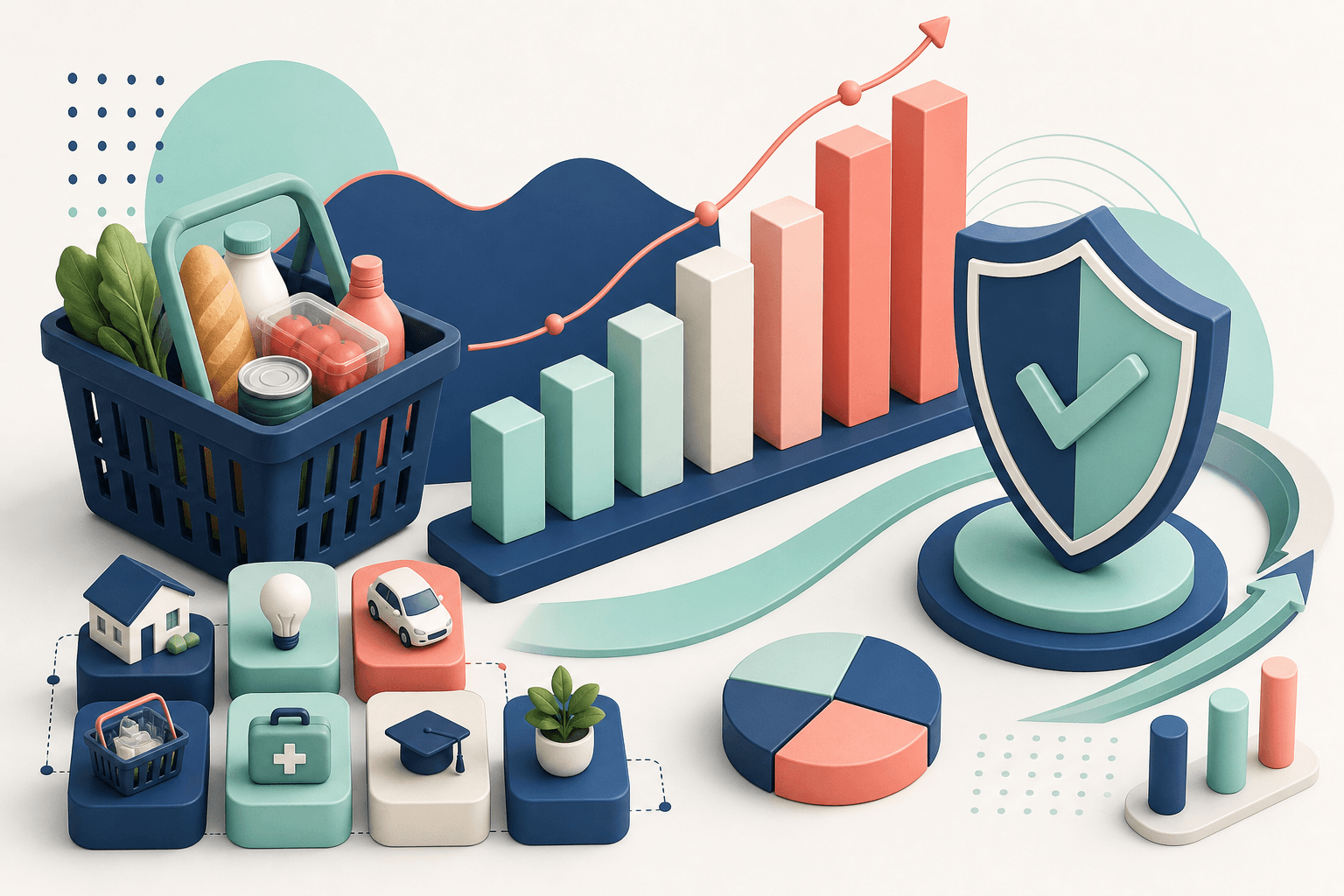
Managing your budget during a period of inflation isn’t just about trying to spend less. You need to measure changes in the amount of goods and services you can purchase with the same income, update your priorities, and review your cash flow more frequently. Since prices rise at different rates, the overall inflation rate alone may not fully explain the changes you experience in your personal budget. The most helpful starting point is to regularly track your own spending basket.
Why does purchasing power vary from person to person?
Official price indices are based on a broad basket of goods and services. However, each household’s consumption weights are different. Someone whose rent makes up a large portion of their budget may be affected by price increases differently than someone with lower housing costs but who spends more on education and transportation. For this reason, the approach known as “personal inflation” helps you see the changes in your own regular spending.
This calculation is not an alternative to official statistics. Its purpose is to understand which categories are putting pressure on your budget. Changes in the quality, quantity, or brand of the same product can also affect the comparison. Noting these details prevents you from drawing incorrect conclusions.
How do you create a personal spending basket?
-
Identify the basic categories
Break down your expenses into housing, food, transportation, energy, health, education, communication, and other regular expenses. The categories should reflect your lifestyle; you shouldn’t unnecessarily expand the list with details you don’t use.
-
Select comparable items
Track a few products or services you purchase frequently from each category. Price comparisons are more meaningful if package size, brand, usage amount, and plan details remain the same. Looking only at the label price when there are changes—such as a reduction in weight—can mask a loss in purchasing power.
-
Calculate monthly expenses
Determine a category’s share of your total essential expenses. Changes in food prices have a greater impact if food accounts for a large portion of your budget. Calculating these shares based on actual spending over at least three months can reduce fluctuations specific to a single month.
-
Record data on the same dates
Choose a consistent time for tracking, such as the first week of the month or after payday. Note the type of price—whether it’s a promotional price or the regular price—to avoid mixing them up. For contracted expenses like subscriptions and rent, also record the date of any changes.
How can you rebalance your budget during a period of inflation?
Simply increasing last year’s category limits by a general percentage isn’t always enough. First, review the actual amounts from the past two or three months. Then, categorize expenses into three groups:
- Essential and non-adjustable in the short term: Obligations such as rent, basic utility bills, and loan installments.
- Mandatory but adjustable: Expenses where the amount or method can be partially adjusted, such as food, transportation, and energy consumption.
- Discretionary expenses: Expenses that can be postponed, reduced in frequency, or covered by alternative options.
Subtract the current total of the first group from your income. Set new limits for the second group based on realistic usage levels. Divide the remaining amount among goals, a safety net, and discretionary spending. If the budget shows a deficit, instead of ignoring it, clearly note which line item, date, or goal will be reevaluated.
Cash flow is not the same as a budget
Even if your monthly total income appears to cover expenses, there may be mismatches between payment dates. Rent, installments, and bills that come in before your paycheck can create temporary cash flow problems. Therefore, you must track not only the amounts but also the dates. Create a payment calendar, spread out recurring expenses across the weeks, and determine in advance the minimum amount that should be in your account.
Recording credit card spending only when the statement is paid makes the amount appear higher than it actually is on the day the purchase was made. Ensure your tracking method consistently accounts for the difference between the purchase date and the payment date. A credit card limit is not additional income; it adds a liability to your future cash flow.
5 Metrics for Tracking Purchasing Power
- Ratio of essential expenses: An increase in the ratio of essential expenses to net income may indicate that your financial flexibility is shrinking.
- Cost of the same basket: The total change, month-over-month, in the cost of a basic basket of the same quantity and quality.
- Unit price: Cost per kilogram, liter, unit of use, or service unit; this makes changes in package sizes visible.
- Difference between income growth and expense growth: Compares the rate of change in your income to the rate of change in your basic expenses.
- Target contribution ratio: The ratio of the amount you can allocate to financial goals to your income; it shows the impact of budget pressure on your long-term plan.
Do not interpret these metrics based on a single month. One-time items, such as healthcare expenses or annual insurance payments, can skew the results. Using a three-month moving average or comparing to the same period last year helps you understand seasonal effects.
Budget Discipline in the Face of Price Increases
Shop with a list and check unit prices
Preparing a shopping list in advance can help prevent promotional offers from leading to unplanned purchases. Don’t assume that a larger package is always more economical; evaluate both the unit price and whether you’ll actually use the product.
Compare subscriptions to how often you use them
Keep track of each subscription’s current fee, expiration date, and renewal schedule. Automatic payments that seem small can add up to a significant budget item. Decide whether to cancel or change your plan based on your actual usage needs.
Set aside a monthly allowance for irregular expenses
Divide the current estimated amount for expenses such as maintenance, school fees, taxes, or annual memberships by the number of months. Making this amount visible in your monthly plan reduces the need to make sudden cuts from other categories when payment time comes.
Asset values are not budget performance
Changes in the prices of foreign currencies, precious metals, or securities can affect your overall portfolio outlook; however, these changes are not the same as your monthly savings. Tracking net contributions separately from market-driven value changes allows you to better understand your actual budget behavior. Portfolio data is an input for decision-making; it is not a buy-or-sell recommendation or a guarantee of future performance.
The value of physical assets, such as a home or a car, is also not fixed or automatic. In biriqim, users manually record estimated values for these types of assets. Adding a date and a note when updating the estimated value makes it easier to understand the source of changes in the overall view.
How can you make tracking sustainable?
During periods of inflation, checking prices too frequently can increase anxiety. Instead, establish a consistent rhythm, such as weekly spending checks and monthly budget reviews. Focus on the few categories that have the greatest impact. When you exceed a limit in a category, instead of blaming yourself, identify the cause: price increase, quantity increase, one-time need, or a recording error.
biriqim can be used to track and analyze income, expenses, goals, and asset data. The app does not perform banking, payment, money transfer, or investment transactions. The visualized data helps you understand your own financial situation; it does not make decisions on your behalf.
Frequently Asked Questions
How do I calculate my personal inflation rate?
You can examine price changes in your own spending categories along with their weightings in your budget. The result is an approximate personal indicator; it does not replace the official inflation measurement.
Should I update my budget every time prices change?
You don’t need to rebuild your budget from scratch with every change. It may be more sustainable to address major contract changes immediately and handle other categories during your scheduled weekly or monthly review.
Do increases in asset prices offset the loss of purchasing power?
This cannot be automatically assumed. Asset prices fluctuate and are influenced by taxes, costs, liquidity, and personal obligations. Past performance does not guarantee future results.
Track budget changes at a glance
Explore tracking and analysis tools on the features page. Download biriqim to create your own budget rhythm.