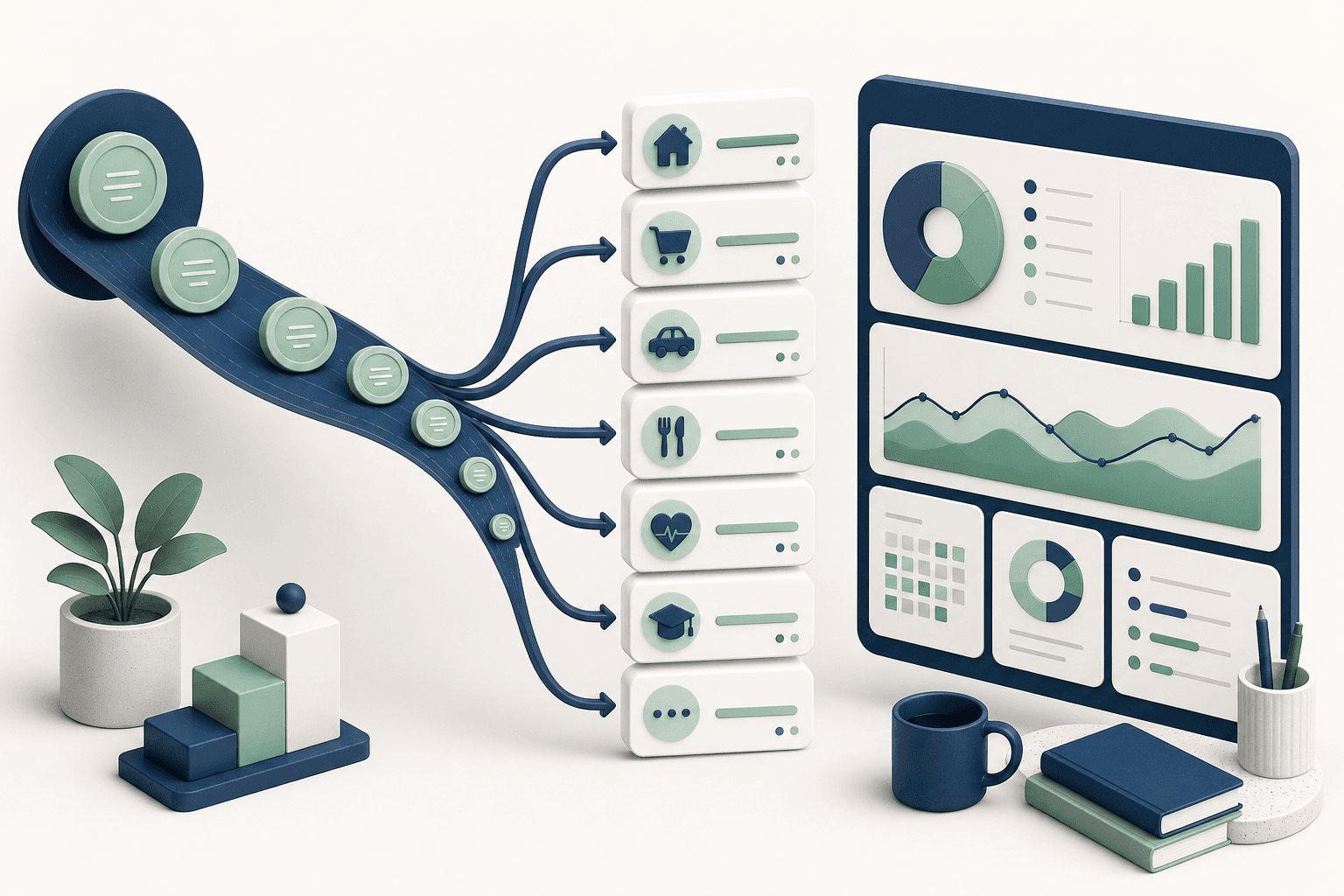
It’s very common to think, “Where did the money go?” a few weeks after payday, even though everything seemed under control on the day your paycheck hit your account. The reason is often not a single large expense, but rather small payments spread throughout the day, irregular bills, and recurring subscriptions that go unnoticed. Tracking your monthly spending isn’t about restricting yourself—it’s about seeing the actual flow of your money and basing your decisions on concrete data.
A good tracking system doesn’t require you to memorize every penny. What matters is being able to see your income, essential expenses, discretionary spending, and periodic payments all within the same framework. The method below helps you establish a sustainable habit of tracking your income and expenses without having to create complex spreadsheets.
Why is monthly expense tracking important?
Your current bank account balance doesn’t show your available spending money on its own. Credit card charges that haven’t been processed yet, upcoming bills, or annual insurance premiums may not be reflected in that balance. When you keep track of your expenses, you’re not just assessing your current situation—you’re also evaluating the obligations you’ll face by the end of the month.
Regular tracking answers three key questions:
- How much of my income goes toward essential expenses?
- In which categories am I spending more than I planned?
- How much is actually left at the end of the month for my savings goal?
Once the answers to these questions are clear, instead of a vague intention like “I need to spend less,” you can make a measurable decision, such as “I’ll reduce my dining-out budget by 15 percent next month.”
Take a snapshot of your financial situation before you start
You can start tracking in the middle of the month; you don’t have to wait for the new month. First, gather your bank transactions, credit card transactions, cash payments, and recurring payments from the last 30 days. Be careful not to record the same expense twice—once as a credit card transaction and again as a credit card payment. A credit card payment isn’t a new expense—it’s the settlement of a previously incurred expense.
Record income as net amounts
List the net amounts deposited into your account separately—such as salary, side jobs, rental income, or regular support. Do not treat bonuses that haven’t been finalized or expected sales revenue as realized income. If you have variable income, basing your budget on the low average of the last three or six months will prevent you from creating an overly optimistic budget.
Separate fixed, variable, and seasonal expenses
Payments with largely fixed amounts—such as rent, maintenance fees, and loan installments—are fixed expenses. Groceries, transportation, and social activities, however, can vary from month to month. Infrequent payments, such as car maintenance, annual memberships, or school expenses, are periodic expenses. Including a periodic expense in your monthly plan by dividing its annual total by 12 prevents your budget from being thrown off track in the month it occurs.
Step-by-Step Monthly Expense Tracking
- Choose a place to keep track: You can use a notebook, a spreadsheet, or a personal finance app. Keeping records scattered across multiple places makes it harder to compare them.
- Create basic categories: Housing, groceries, transportation, healthcare, debts, personal needs, and social life are a sufficient starting point for most people.
- Enter transactions promptly: Record cash expenditures on the same day and card transactions no later than your weekly review. Skipping small amounts distorts the overall picture.
- Compare planned and actual amounts: Track not only how much you’ve spent but also how far you’ve deviated from your initial goal.
- Do a quick weekly review: A 10-minute review helps you spot surprises early on that you might otherwise encounter at the end of the month.
- Close out the month and take notes: Write down the reason for the deviation in a single sentence. A note like “Grocery bill went up because of guests” provides context when reviewing the next month.
Ways to Make Small Expenses Visible
Payments like coffee, delivery fees, in-app purchases, or short-distance transportation may seem insignificant on their own. However, when they occur frequently, their monthly totals become noticeable. Instead of banning these expenses entirely, evaluate them based on frequency and total amount. For example, instead of creating a separate “coffee” category, it might be simpler to track the weekly total under the “dining out” category.
Recording your expenses immediately after shopping, rather than saving receipts, makes the process easier. If you’re using an OCR-enabled tool, it can speed up data entry by reading the date, business name, and total amount from receipts or invoices. Smart edge detection helps identify the document’s borders; however, folded paper, faint printing, or low light can affect the results. Therefore, it’s important for you to review the generated entry and correct it if necessary.
Weekly and Monthly Review Routine
Once a week: Catch discrepancies early
Compare your records with account transactions on the same day each week. Include pending card transactions, cash payments, and automatic debits. If a category has used up a large portion of its monthly limit in the first few weeks, make a conscious adjustment for the remaining days. The goal is not to feel guilty, but to manage the plan with up-to-date information.
At the end of the month: Focus on three key figures
Total income, total expenses, and the difference between them are your key results. Then examine the top three spending categories. Determine whether the increase is one-time or ongoing. Treating a one-time healthcare expense as part of your normal cost of living—or treating steadily rising subscription fees as exceptions—will lead to incorrect conclusions.
Don’t view savings solely as the money left over at the end of the month. If possible, set aside your target amount in a separate account as soon as income comes in, and track it as a planned expense. Tracking and analysis tools like biriqim can help you view your records in one place, compare categories, and analyze trends; they don’t handle your financial transactions for you.
The Most Common Mistakes in Tracking Expenses
- Too much detail: Creating dozens of categories makes the tracking process tedious.
- Forgetting cash payments: Small payments, in particular, can create an unexplained discrepancy at the end of the month.
- Counting credit card debt twice: Recording both the transaction as an expense and the debt payment as an expense inflates the total.
- Checking only at the end of the month: There’s no room left to correct deviations noticed too late.
- Viewing every deviation as a failure: A budget is a living plan; it can be updated to account for unexpected situations.
Frequently Asked Questions
On which day of the month should you start tracking your expenses?
You can start today. Treat the first 30 days as an observation period; set your goals for the following month based on your actual data. It’s also possible to use the period between two paydays instead of the calendar month.
Do I need to record every small expense?
Yes, to get a realistic total. However, you don’t need to list every item separately; adding the total from your grocery receipt to the appropriate category is usually sufficient. The key is to consistently follow the method you choose.
Which expense tracking method is better?
The best method is the one you can stick with. Manual recording can increase your awareness; scanning receipts and using automatic calculations can save you time. Whichever tool you choose, you’ll need to review your records regularly.
Make your cash flow visible today
Set up your tracking system with a simple list of categories, schedule a weekly review, and treat the first month as a learning period. You can explore biriqim’s tracking and analysis features on the features page and download the app for the device that works best for you.