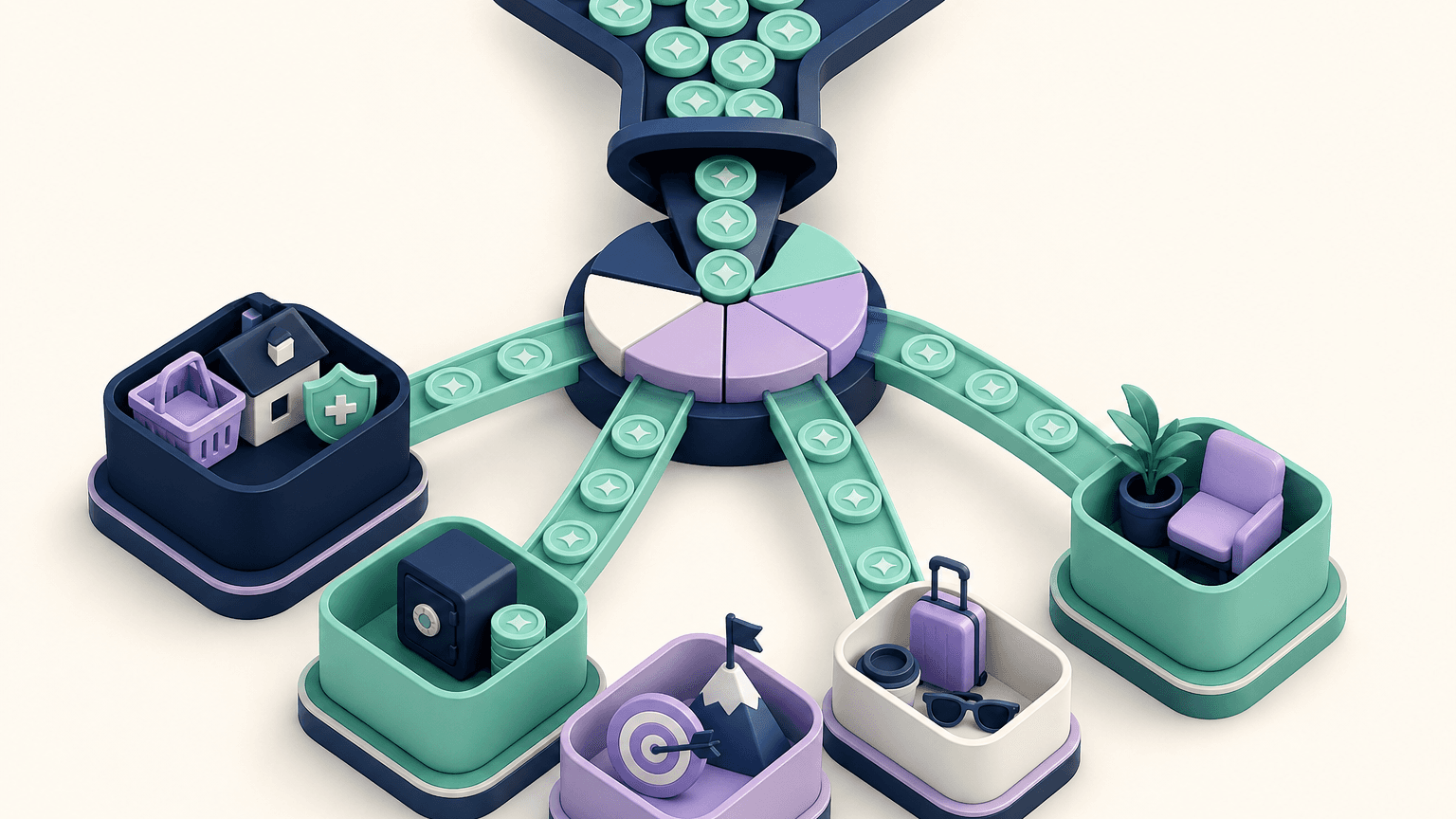
Zero-based budgeting is a method of allocating the entire expected income for a given period to specific purposes before any spending takes place. When planned living expenses, debt payments, allocations for periodic expenses, savings, and other goals are subtracted from income, the planned balance reaches zero. The “zero” here does not mean that there is no money left in your account or that all income has been spent; it means knowing exactly which needs or goals each available amount is allocated to.
This approach can be particularly helpful in reducing the question, “Where did my money go at the end of the month?” However, it is not a rigid template that allocates the same amount to the same category every month. When income, priorities, or expenses change, the allocation is adjusted accordingly. The goal is not to make perfect predictions, but to make changes visible and conscious.
What is the basic logic behind zero-based budgeting?
The method’s simple equation is as follows: expected income minus planned expenses, goals, and allocated amounts equals zero. The term “expenses” does not cover consumption alone. An emergency fund, an amount set aside for a specific goal, or preparation for next month’s recurring payment are all tasks assigned to money. Therefore, zeroing out the plan does not mean zeroing out the financial buffer.
For example, when an amount is set aside for groceries, it serves a consumption purpose; when set aside for annual maintenance, it serves a periodic preparation purpose; and when set aside for savings, it serves a goal-oriented purpose. The portion of the grocery budget that remains unused at the end of the month does not have to go to waste; it can be reallocated to the next period, a reserve for periodic expenses, or another goal. The essence of the method is to ask the question, “What purpose will this money serve now?” with every change.
How does it differ from a traditional budget?
In a general budget, limits may be set for a few main categories, and a portion of the revenue may be left unallocated. In the zero-based approach, however, even the unallocated amount is explicitly tied to a category or objective. This is not to create spending pressure, but to prevent the unaccounted-for free balance from being spent haphazardly.
The method does not automatically copy figures from the previous month. New conditions are assessed at the beginning of each period. Energy costs in the winter, educational expenses during the school year, or changes in revenue may require a different allocation. Thus, the budget becomes a plan based on current priorities rather than a formula based on fixed ratios.
How do you prepare a zero-based budget?
-
Determine the budget period and available income
Choose a calendar month or the period between two income dates. List your salary and other confirmed income as net amounts. Keep income that hasn’t been realized yet—such as bonuses, project payments, or sales—in a separate “what-if” scenario rather than including it in the base plan.
-
Allocate mandatory expenses
Start with housing, basic bills, food, transportation, healthcare, education, and contractual debt payments. For mandatory items with varying amounts, use past actual records. Adding payment dates allows you to see not only the total budget but also the timing of cash flow.
-
Allocate funds for periodic expenses
List predictable expenses that don’t occur every month, such as annual memberships, maintenance, insurance, gifts, or back-to-school shopping. You can create a contingency fund by dividing the expected amount among the remaining months. If the amount is uncertain, note your estimate and update it as new information becomes available.
-
Treat savings and goals as separate tasks
Make goals—such as emergency savings, a short-term purchase, or long-term savings—visible as separate line items in your budget. These amounts haven’t been spent; they’ve been set aside for a specific purpose. The size and priority of these goals vary depending on your personal circumstances.
-
Plan flexible spending realistically
Setting a budget of zero for social activities, dining out, hobbies, and personal preferences isn’t always sustainable. Set limits that align with your past behavior and priorities. The goal isn’t to feel guilty, but to see how your choices impact your other goals.
-
Reallocate the remaining difference
If there’s a positive balance after subtracting all budget items from your income, assign a purpose to it. If the result is negative, instead of trying to make it appear as though your income has increased, first review your flexible expenses, then your deferrable goals, and finally your major expense assumptions. A persistent deficit may require a more comprehensive assessment.
How to manage your budget throughout the month?
Keep planned and actual figures separate
Don’t replace the initial plan with actual expenses. Show the planned, actual, and remaining amounts separately for each category. This way, you’ll see not just the balance but also which assumptions didn’t hold up. Adding a change note when an unexpected expense arises strengthens next month’s plan.
Record transfers between categories
If grocery expenses exceed the budget, you can transfer funds from another category; however, make sure to document the transfer. A brief note, such as “Transferred from social life to groceries,” explains why the total still equals zero. An additional amount without a specified source can make the budget appear balanced even though it’s actually in the red.
Assign a purpose to new income as well
If unplanned income arises during the month, you don’t have to immediately allocate it to an expense category. You can reallocate it among upcoming mandatory payments, recurring expenses, savings, or another priority. The choice is personal; what matters is that the amount isn’t left unaccounted for and untracked.
Can a zero-based budget be applied to irregular income?
It is possible, but a layered plan is more useful than a single, optimistic income estimate. First, establish a baseline plan using a more conservative income estimate with a high likelihood of being realized. Prioritize mandatory expenses; then prepare a second allocation sequence to be used when variable income comes in. For example, upcoming obligations, preparations for periodic expenses, and flexible targets can be prioritized.
Do not count uncollected receivables as available cash. Determining in advance which items can be deferred if an expected payment is delayed reduces pressure at the moment of decision. Zero-based budgeting does not eliminate uncertainty; it makes visible which categories are affected by uncertainty.
Strengths and Challenges of the Method
- Provides visibility: It can reduce the unnoticed spending of unallocated balances.
- Clarifies priorities: Savings and preparation for seasonal expenses are incorporated into the plan.
- It’s flexible: Allocations can be readjusted each month based on new conditions.
- Requires regular effort: If records aren’t updated, category balances quickly lose their meaning.
- Carries the risk of excessive detail: Too many categories can make the method unsustainable.
- Does not guarantee definite results: Unexpected expenses and changes in income can affect the plan.
Common Misconceptions
The most common misconception is equating the word “zero” with having no money. The amount allocated to a savings account still belongs to you; it’s simply earmarked for a specific purpose. The second mistake is trying to spend every category’s balance before the end of the month. Any unspent portion can be reallocated. The third mistake is treating the budget as set in stone. Updating the plan isn’t a failure of the method—it’s adapting to new information.
Frequently Asked Questions
Does a zero-based budget mean resetting the account to zero?
No. It means assigning a purpose to all of your planned income. Savings, an emergency fund, and a reserve for seasonal expenses are all designated purposes; you don’t have to spend all of your money.
Should the budget be redone from scratch every month?
You can use the previous month’s budget as a template; however, you should reassess your income, upcoming expenses, and priorities. Simply copying the numbers reduces the method’s ability to adapt to current conditions.
What happens if there’s money left in a category at the end of the month?
You can reallocate the remaining amount to the next period, an upcoming expense category, or a goal of your choice. You don’t have to spend it automatically or leave it in the category without a purpose.
Does every expense need its own category?
No. Simple main categories that help you make decisions are sufficient. Excessive detail increases the burden of record-keeping; meaningful subcategories can be added as needed.
Make the purpose of each amount clear
Explore biriqim’s features to track your income and expenses by category and analyze your periods; download biriqim to start keeping budget records. biriqim is solely a tracking and analysis tool; it does not process transactions, transfer funds, extend credit, or facilitate structuring or trading.