What Is Cash Flow? A Guide to Balancing Income and Expenses
Track your cash flow by income and expense dates; by identifying payment peaks early on, you can plan your budget more realistically and minimize surprises.
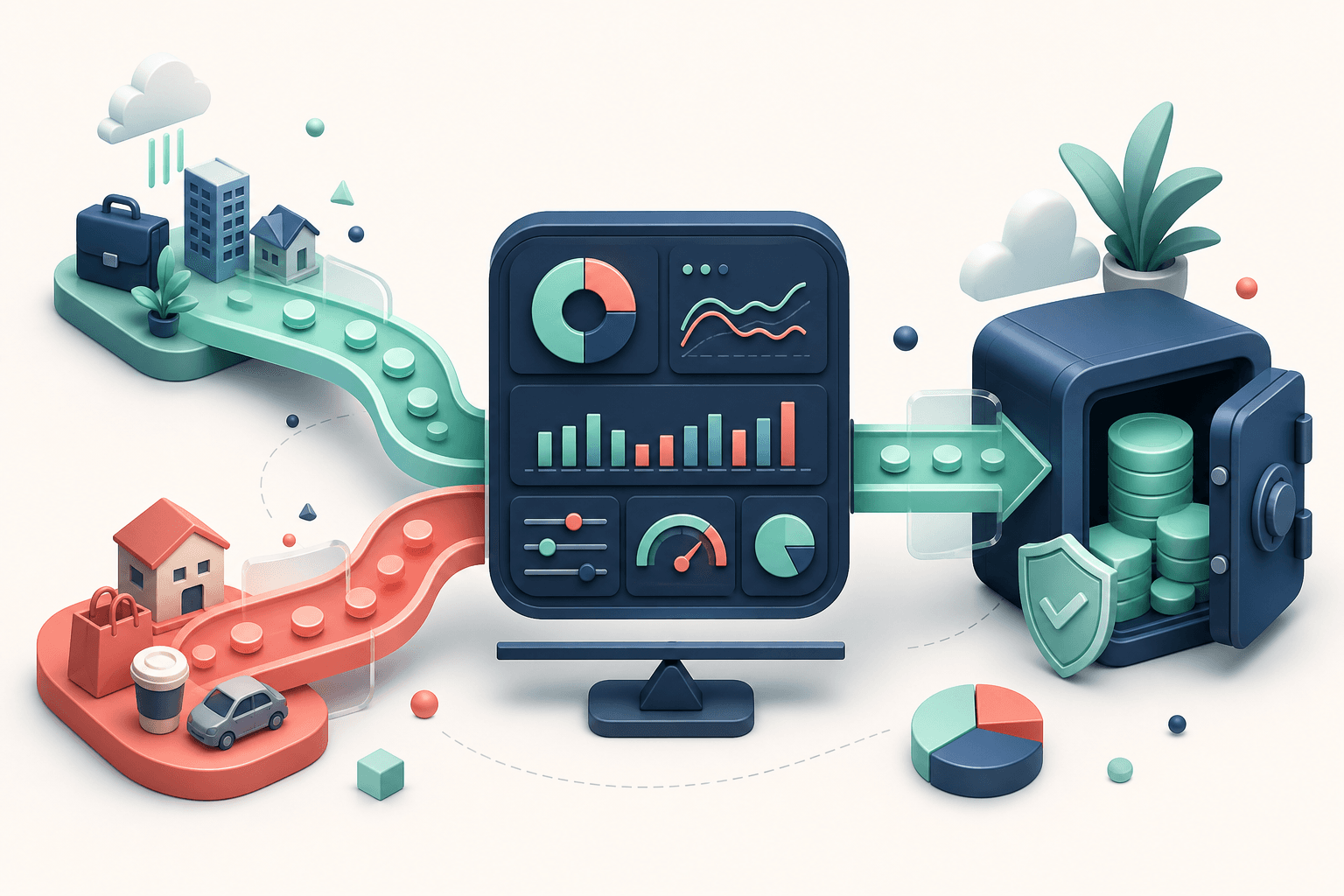
Even if your income exceeds your expenses throughout the month, you may not have enough money in your account on payday. This is not just a matter of how much you earn or spend, but also of when the money comes in and goes out. Cash flow shows the movement over time of actual and expected cash inflows and outflows during a specific period.
What is cash flow?
Personal cash flow involves tracking income—such as a salary, freelance payments, rental income, or other sources—alongside expenses like rent, bills, loan payments, groceries, and transportation. Payment dates are just as important as monthly totals. A paycheck received on the 15th of the month is not yet available to cover rent due on the 5th.
Tracking cash flow does not mean knowing your future balance with certainty. Unexpected expenses, delayed collections, and fluctuating amounts can change the outcome. Still, a view based on recorded transactions helps you spot upcoming payment peaks early on.
What is the difference between cash flow and a budget?
A budget shows how much money you plan to allocate to specific categories. Cash flow, on the other hand, tracks when money enters and leaves your account. The two tools complement each other but are not the same.
For example, you might have allocated 4,000 TL in your budget for monthly bills. If all the bills are due the week before payday, a short-term cash shortfall could occur even if the overall budget appears balanced. A cash flow calendar highlights this timing issue.
What do positive and negative cash flow mean?
- Positive cash flow: During the period under review, cash inflows exceed outflows. The difference can provide room for savings, debt reduction, or expenses in future periods.
- Negative cash flow: Cash outflows exceed inflows. This situation may result from a one-time planned expense or may indicate a recurring budget deficit.
- Balanced cash flow: Inflows and outflows are roughly equal. Since there is no buffer for a small unexpected expense, this situation can be fragile.
A single month with a negative cash flow doesn’t always mean there’s a problem. Annual insurance, moving, or education payments may have been scheduled to fall in that month. The key is to understand the cause, distinguish between a temporary situation and a recurring deficit, and assess its impact on future periods.
How do you calculate your personal cash flow?
1. Choose a time period
A monthly view is a good starting point; however, a weekly review can also be helpful for understanding payment dates. If your income is irregular, 30-, 60-, or 90-day periods may provide a broader perspective.
2. Record all cash inflows
List your salary, side jobs, rent, refunds, and other collections along with their dates. Do not count income that hasn’t been finalized yet as if it were already received. Keep expected receivables separate to make the possibility of delays visible.
3. Include fixed and variable expenses
In addition to fixed payments like rent, installments, and subscriptions, use estimates based on actual records for variable expenses such as food, transportation, and healthcare. Don’t forget to include annual or quarterly payments along with their due dates.
4. Calculate the net cash flow
Subtract the total expenses for the selected period from the total income. The result indicates the overall trend; you’ll also need the opening balance and the date of each transaction to calculate the daily balance. Even if a month’s total is positive, a specific day within that month may carry the risk of a negative balance.
5. Compare with actual data
At the end of the period, examine the difference between the estimated and actual amounts. If a category is consistently underestimated, use more realistic figures in your next plan. If collections are frequently delayed, add a safety margin to the expected revenue date.
How do you balance income and expenses?
Mark mandatory payments on the calendar
First, enter basic expenses such as rent, bills, healthcare, transportation, and minimum debt payments. If payments are concentrated in the same week, you can discuss payment schedule adjustment options with the service provider if possible and if the terms allow. Check the fees and contract terms for each change.
Set a weekly limit for variable expenses
Splitting your monthly grocery or social life budget into weekly portions can help reduce overspending at the beginning of the month. Any unused weekly portion doesn’t have to be spent automatically; it can be carried over to the next week, added to savings, or used toward an upcoming mandatory payment.
Use a conservative baseline for irregular income
Treating an exceptionally good month as the standard can be misleading. Use the more conservative income level from past periods as the basis for your budget, and allocate the excess to a buffer, tax obligations, or goals. The appropriate method depends on your income structure.
Separate expected receivables from your available balance
Issuing an invoice does not mean the money has been deposited into your account. Mark the collection as “expected” on your cash flow calendar; confirm it once it’s received. This way, a delayed payment won’t be mixed in with your current balance.
What is the purpose of a cash flow forecast?
A cash flow forecast uses recorded recurring income, scheduled payments, and past transactions to indicate the likely direction of your future balance. The goal isn’t to produce an exact result, but to identify upcoming tight periods in advance. A new expense, a canceled subscription, or a delayed paycheck can change the forecast.
The AI-powered cash flow forecast in biriqim is a Pro feature and offers analysis options for 7, 30, 60, or 90 days. The Free plan offers 500 entries per year, 100 OCR scans for life, and does not include AI. The Pro plan offers unlimited entries, 500 OCR scans per year, AI-powered features, and reports. This analysis is a forecast based on entered and current data; it is not financial or investment advice and does not guarantee future balances. Consider the results not as the decision itself, but as a planning signal that should be verified.
Useful fields to include in a cash flow statement
- Transaction or expected transaction date
- Revenue or expense type
- Category and brief description
- Amount and currency
- Frequency of recurrence
- Status: Expected, Occurred, or Overdue
- Estimated balance after the transaction
If you can’t maintain a highly detailed system, start with fixed payments, income dates, and major variable expenses. Once you’ve established a habit of recording transactions, you can add smaller items.
Common cash flow mistakes
- Treating your credit card limit as income
- Treating expected receivables as already collected
- Failing to set aside funds to account for annual payments in your monthly budget
- Looking only at the end-of-month total and missing the shortfall on interim dates
- Underestimating variable expenses
- Interpreting estimates as definitive results or recommendations
Frequently Asked Questions
How often should cash flow be checked?
A quick weekly check and a monthly review are a practical starting point for most people. Those with irregular income or a busy payment schedule may want to check more frequently.
When is a credit card charge recorded as an expense?
From a budgeting perspective, the expense is recorded on the transaction date; from a cash outflow perspective, it is recorded on the date the credit card balance is paid. It’s important to distinguish between these two views without creating duplicate entries.
Does a positive cash flow guarantee financial success?
No. A positive cash flow merely indicates that inflows exceeded outflows during the period under review; debt, risk, goals, and long-term conditions must also be evaluated.
View upcoming cash flows
Discover biriqim’s features to track income, expenses, and scheduled payments all in one place. Download biriqim to start tracking your cash flow.
This content is for general informational purposes only; it is not financial or investment advice. Forecasts do not guarantee specific results and should be evaluated based on your personal circumstances.
Personal finance console
See your full financial picture in one place
Say goodbye to scattered spreadsheets and switching between multiple banking apps; see your entire financial picture at a glance with biriqim.
- Portfolio management
- Income and expenses
- Total assets
- Start without signing up
- Tracking only — no trading
- Multilingual experience
Free to download — no credit card required
biriqim is strictly a personal finance tracking, budgeting, and analysis tool. No live financial transactions, money transfers, or trading can be executed through the application.
Total Assets
1.245.680 ₺
+12.4% Today
Profit
+12.4%
Loss
-2.1%
+12.4%
Profit
1.24M ₺
Total Assets